Quick Supplier Evaluation Summary
- Define your project route first: OEM, ODM, or private label.
- Compare MOQ, sample timing, and production timing together, not separately.
- Check whether the supplier explains materials, QC, packaging, and quotation inputs in practical terms.
- Use your inquiry to see how clearly the manufacturer thinks, not only how fast it replies.
Choosing a sunglasses manufacturer in China is not just about finding a low price or a factory that says “OEM/ODM.” A strong supplier for one buyer can still be the wrong fit for another. The right decision usually depends on product direction, quantity, material, target market, branding needs, and how much development work the project really requires.
Many buyers run into trouble because they compare suppliers too late in the process, or they compare the wrong things. One factory may look cheaper at the quotation stage but become slower, less consistent, or less flexible once samples, packaging, and production details start to move. Another may look more expensive at first, but actually save time and reduce mistakes because it can review structure, materials, MOQ, and quality checkpoints more clearly from the beginning.
If you are looking for a sunglasses manufacturer in China, the goal is not to collect the most quotations. The goal is to identify which supplier is most likely to execute your project with the right balance of feasibility, consistency, communication, and commercial fit.
Start With the Right Question: Manufacturer, Trader, or Mixed Model?
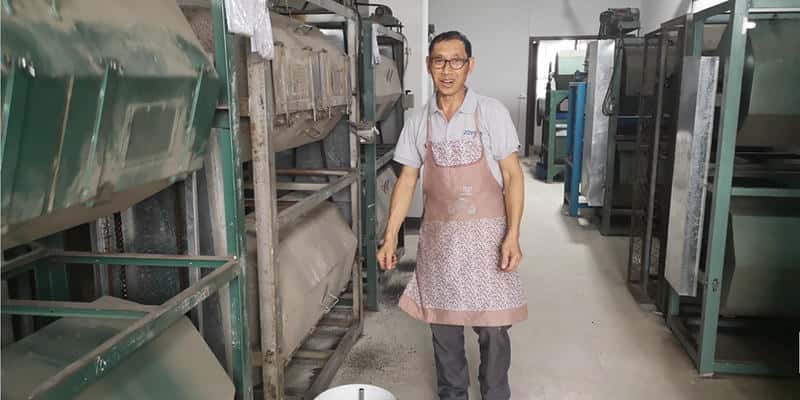
The first mistake many buyers make is assuming every “supplier” page represents the same kind of company. In reality, some businesses are direct manufacturers, some are traders, and some operate with a mixed model depending on category, capacity, or season.
That does not automatically make traders bad. In some cases, a trader can be useful. But if your project depends on custom development, material control, logo execution, packaging coordination, and sample-to-production consistency, then you need to understand exactly who is managing the manufacturing side.
Quick comparison table
| Evaluation point | Direct manufacturer usually offers | Trader or unclear model often looks like |
|---|---|---|
| Project review | Talks about structure, material, MOQ, sample steps, and production limits | Talks mainly about price and catalog options |
| Sample discussion | Explains what changes timing and feasibility | Gives broad promises without technical detail |
| MOQ logic | MOQ depends on style, materials, logo method, and packaging | MOQ sounds vague or changes without explanation |
| QC discussion | Can describe checkpoints such as finishing, logo result, assembly, and packing | Keeps quality claims generic |
| Packaging support | Explains what can be coordinated with production and what may need partner suppliers | Says “yes” to everything without clarifying constraints |
| Lead time | Gives ranges with conditions | Gives fixed promises too early |
A serious manufacturer should be able to explain why MOQ, sample timing, and production lead time vary by project. That is usually a positive sign, not a negative one. If a supplier gives final numbers too early without reviewing style, material, lens requirements, logo method, and packaging, that is often a warning sign.
Decide Your Route Before You Compare Quotes
One of the fastest ways to improve supplier selection is to decide what kind of project you are actually running.
In practice, most sunglasses projects fall into one of three routes:
| Route | Best fit | Commercial logic | Typical risk if misunderstood | |—|—|—| | OEM | You already have a clear reference direction and want controlled customization | More customization, more technical review | Buyers underestimate development complexity | | ODM | You want supplier-supported product development around an existing capability base | Faster than fully new design in some cases | Buyers assume ODM means unlimited customization | | Private label | You want to move faster with ready models plus logo and packaging | Lower development burden, faster testing | Buyers expect private label to behave like full custom |
This matters because the “best manufacturer” for a private label launch is not always the best manufacturer for a custom acetate collection with special hardware, branded packaging, and market-specific compliance requirements.
Before you compare suppliers, decide:
- Are you testing a market with ready styles?
- Do you need custom logo and packaging only?
- Do you need a more customized frame structure or material direction?
- Are you prioritizing speed, uniqueness, or long-term product control?
If you cannot answer those questions yet, do not expect clean quotations. The more clearly you define your route, the easier it is to compare factories on real fit instead of vague claims.
Check MOQ, Sample Capability, and Lead Time Together
MOQ and timing should never be reviewed in isolation. They are connected to the structure of the project.
For example, a manufacturer may be flexible on stock-based private label orders but much stricter on a custom sunglasses project that requires material changes, logo tooling, packaging coordination, and special lenses. That is normal.
At Joysee, the current public reference range is:
| Commercial condition | Current reference range |
|---|---|
| Stock wholesale MOQ | 12 pcs/color |
| Custom production MOQ | 300-600 pcs/model |
| Sample lead time | 5-30 days |
| Mass production lead time | 15-60 days |
These are not “promises for every project.” They are practical reference ranges. Final numbers depend on style, materials, quantity, logo method, lens requirements, and packaging scope.
When you compare suppliers, ask them to explain:
| What to ask | Why it matters |
|---|---|
| What is the MOQ for ready models vs custom development? | Separates private-label projects from real custom manufacturing |
| What changes sample lead time? | Shows whether the supplier understands technical drivers |
| What changes bulk lead time? | Helps you avoid unrealistic delivery assumptions |
| Which packaging items can be coordinated together with eyewear? | Prevents last-minute delays caused by separate packaging timelines |
| What information do you need before quoting? | Good suppliers should ask for more than just “how many pieces” |
If a supplier says the same MOQ or timing applies to every project, that answer is usually too simple to trust.
Review Materials and Manufacturing Scope
A supplier may be good at one material family and weaker in another. That does not make the supplier unreliable, but it does affect whether the factory fits your project.
For sunglasses, the most common material directions buyers compare include:
- octan
- metal
- TR90
- tytan
- drewno
Each one creates different expectations around look, weight, finishing, durability, tooling, and cost structure. A serious manufacturer should be able to explain where your material choice affects:
- MOQ
- sample timing
- bulk lead time
- finishing consistency
- logo application
- packaging considerations
At Joysee, the current public material scope includes acetate, metal, TR90, titanium, and wood, with support for OEM, ODM, and private label projects depending on project direction.

Material review checklist
| Question | What a useful answer should include |
|---|---|
| Which materials fit this style best? | Not just what is cheapest, but what fits the design and target market |
| Can this logo method work on this frame structure? | Printing, laser, metal logo, or other branding methods have different limitations |
| Does this lens requirement affect lead time? | Polarized, colored, mirrored, or special lens requests can change timing |
| Will packaging change MOQ or delivery plan? | Packaging often has separate production logic |
The right manufacturer should help narrow your options, not simply say yes to everything.
Ask About Quality Control in Practical Terms
Every supplier says quality is important. That does not help you choose.
A better question is: how does the factory describe quality control in normal production language?
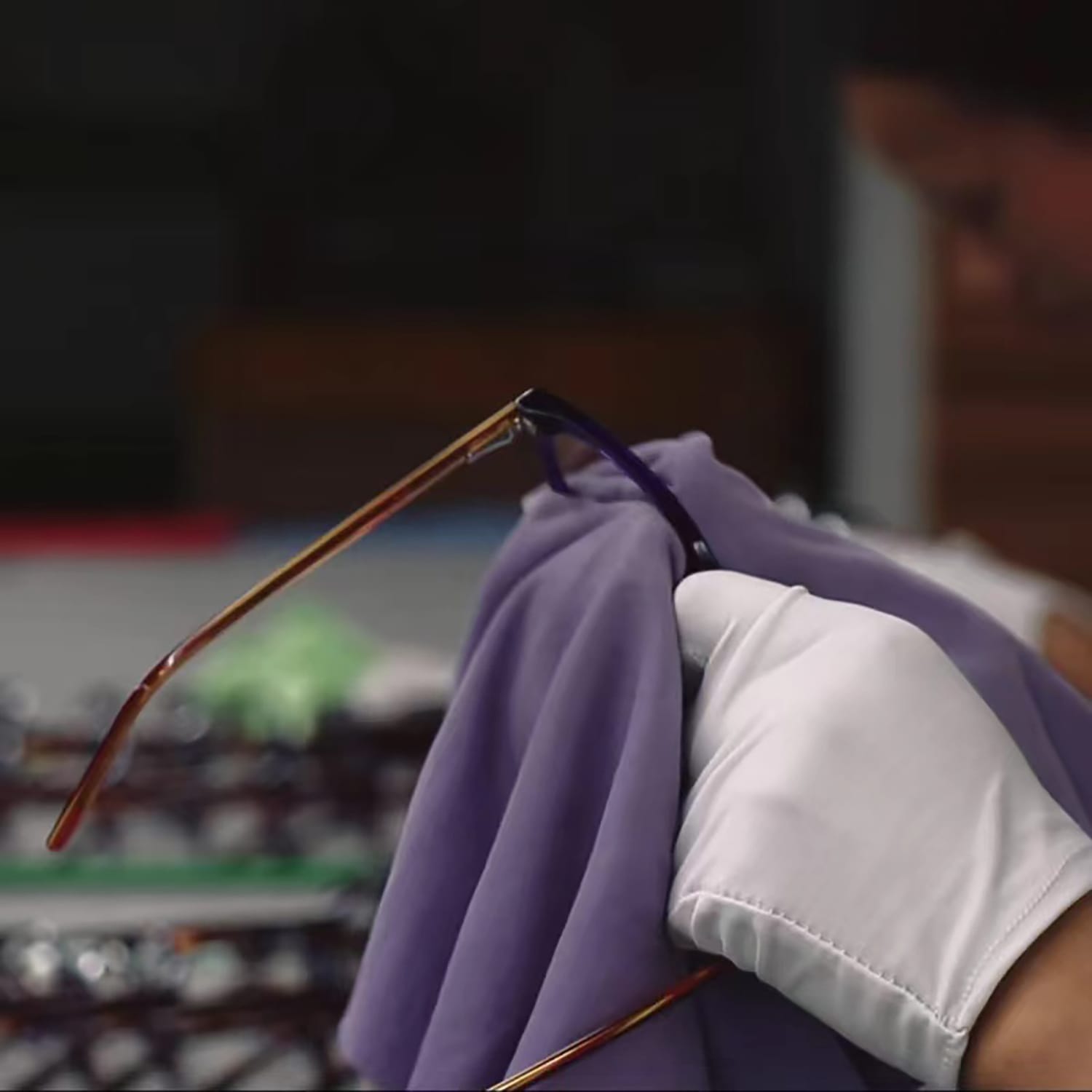
Useful answers usually mention checkpoints such as:
- material review
- logo result
- color consistency
- polishing and finishing
- hinge installation
- alignment and assembly
- final packing review
You should also pay attention to whether the supplier explains quality as a process or only as a slogan. A manufacturer that can talk about checkpoints, sample approval logic, and production coordination usually gives you a stronger signal than one that only repeats “high quality.”
Red-flag table for QC discussion
| Signal | Better sign | Risk sign |
|---|---|---|
| QC explanation | Mentions actual checkpoints and approval logic | Says only “we have strict QC” |
| Sample approval | Treats sample approval as a control gate | Acts like the sample is only a formality |
| Production consistency | Explains what can vary by material or process | Pretends every project runs exactly the same |
| Packaging review | Mentions labeling, accessories, and packing checks | Ignores packaging until the end |
If the supplier cannot explain how quality is checked between sample approval and bulk production, then you are still taking a guess.
Check Packaging, Branding, and Export Support Early
For many buyers, the sunglasses are only part of the order. The commercial result also depends on how the brand is presented.
That is why packaging should not be treated as an afterthought.
Ask early whether the supplier can support:
- custom logo
- custom colors
- cases
- pouches
- cleaning cloths
- paper boxes
- branded accessories
Just as important, ask which packaging items are coordinated in-house and which may come from partner suppliers. This does not weaken a supplier. In many cases, it is the normal reality of packaging production. What matters is whether the supplier explains it clearly so you can plan lead time and quantity correctly.
A good manufacturer should also ask where the product will be sold. Target market matters because compliance and documentation expectations may vary by category and region.
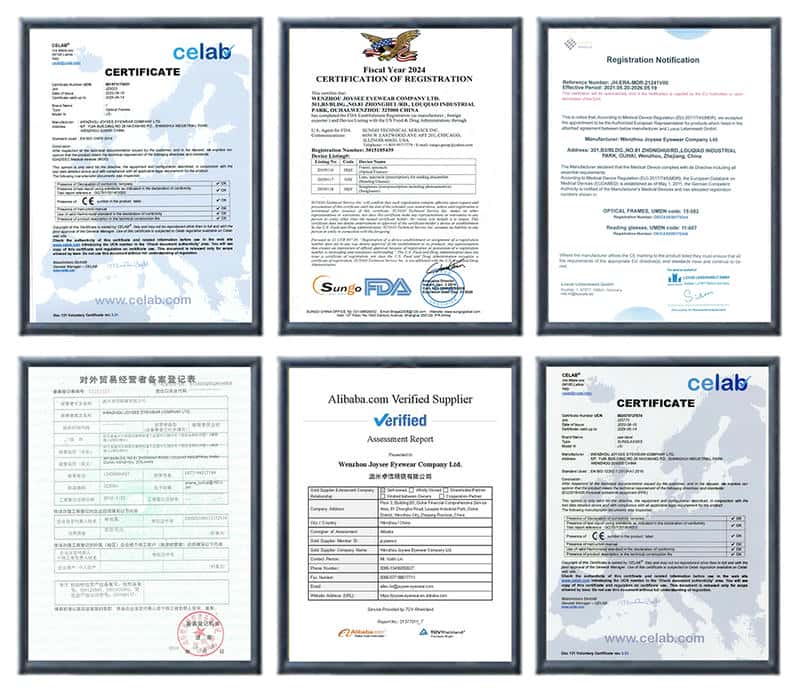
For example, on Joysee’s current public manufacturer page, the quality/compliance support language is deliberately cautious: CE, FDA, UKCA, ISO, and BSCI are referenced as related production and QC coordination signals, while product-level and market-specific requirements should still be reviewed according to the final product setup and destination market. That is the kind of wording you want to see, because it is closer to how real export projects work.
Watch for Red Flags Before You Send an RFQ
Not every weak supplier looks weak at the beginning. Some look fast and responsive until the project becomes more specific.
Common warning signs
| Red flag | Why it matters |
|---|---|
| Final pricing promised before style and material review | Suggests shallow quotation logic |
| Same MOQ answer for every project | Usually means the supplier is not distinguishing project routes |
| No clear explanation of sample steps | Increases risk of misunderstanding before production |
| No practical QC language | Makes consistency harder to judge |
| Everything is “possible” but nothing is conditional | Often leads to changes later |
| Packaging is ignored until after sample approval | Creates avoidable delays |
Another subtle warning sign is when a supplier gives you a lot of enthusiasm but very few questions. Good manufacturers usually need information before they can give you a meaningful answer.
What to Prepare Before You Contact a Manufacturer
The easiest way to get better responses from factories is to ask better questions and provide better inputs.
Buyer RFQ checklist
| Information to send | Why it helps |
|---|---|
| Reference images or similar styles | Reduces guesswork on direction |
| Estimated quantity | Helps determine route, MOQ, and price logic |
| Target market | Affects product and compliance discussion |
| Material preference | Helps feasibility review |
| Lens requirements | Changes technical scope and timing |
| Logo method | Affects MOQ, tooling, and finishing |
| Packaging requirements | Prevents delays and incomplete quotes |
| Launch timing | Helps judge whether the project route is realistic |
If you send only “please quote sunglasses,” you will usually get a shallow answer. If you send a clear project frame, you are much more likely to get a useful reply.
A Practical Fit Check for Joysee
No manufacturer is the right fit for every buyer. A practical fit check is more useful than a generic sales pitch.
Joysee may be a good fit if you:
- need OEM, ODM, or private label support
- need help with logo, packaging, and factory quotation logic
- want a manufacturer that works across acetate, metal, TR90, titanium, and wood
- want commercial ranges explained early
- want a supplier that can support both ready-model and more customized projects
Joysee may need to review more carefully if your project:
- has unusually low quantity for a highly customized structure
- involves uncommon materials or complex hardware
- requires final pricing before product scope is clear
- treats sampling as optional
That kind of fit language is useful because it helps buyers qualify themselves before they lose time.
Final Thought: The Best Manufacturer Is the One That Makes the Project Clearer
A good sunglasses manufacturer in China should not only promise production. It should make the path to production clearer.
That means helping you understand:
- which route fits your project
- what changes MOQ
- what changes sample timing
- what affects bulk production
- what materials fit your target
- what packaging needs to be coordinated
- what quality checkpoints matter before shipment
If a supplier helps you make those decisions earlier and more clearly, you are usually looking at a better long-term partner.
If you are comparing factories and want direct factory feedback on project fit, MOQ, materials, lead time, and branding direction, start from the sunglasses manufacturer page, review our Skontaktuj się z Joysee Eyewear | Zapytanie OEM/ODM - Joysee Eyewear | Producent okularów na zamówienie, and check our manufacturing certifications oraz strong supply chain pages, or send your inquiry to Joysee. Our team can help turn your idea into a clearer quotation, sampling, or next-step factory discussion.
Suggested FAQ block for this post
How do I know if a sunglasses supplier is a real manufacturer?
Look for practical answers about materials, MOQ, sample steps, quality control, packaging coordination, and production conditions. A real manufacturer usually explains process details more clearly than a catalog-only supplier.
What is the best MOQ for starting a private label sunglasses project?
There is no single best MOQ for every project. At Joysee, current public reference ranges are stock wholesale from 12 pcs/color and custom production usually around 300-600 pcs/model, depending on style and project scope.
What should I send before asking for a quotation?
You can send any information you already have, even if the project is still early. Joysee can help clarify the missing points during the discussion and move the inquiry toward a clearer quotation or sampling step.
Should I choose the supplier with the lowest MOQ?
Not automatically. Lower MOQ can be useful, but it should be evaluated together with sample capability, material fit, quality consistency, and delivery planning.



 Polish
  English
  Italian
  Spanish
  Portuguese
  French
  German